Our pick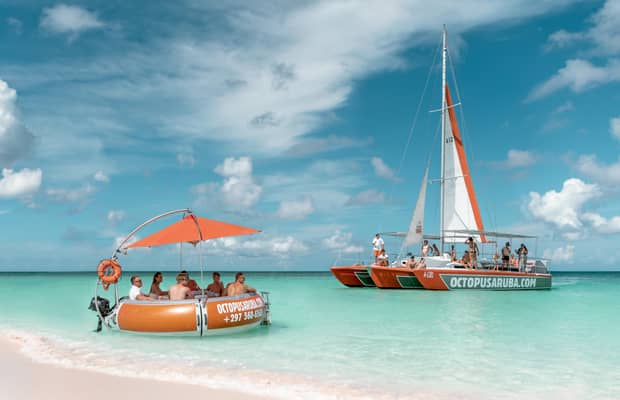
Afternoon Sailing Trip with Snorkeling & Open Bar
Antilla first, then Boca Catalina, with appetizers between them. Highest score of the seven. Catch: you board from the beach by shuttle.
from$74.99
★ 4.8 · 388 reviews
A German freighter, roughly 400 feet of it, scuttled in 1940 off Aruba's north-west coast — and it has been lying in snorkel-depth water ever since, one of the largest wrecks in the Caribbean. That single accident of geography is why the island's entire snorkel fleet sails the same direction every morning. Here is what you actually see, which of the seven boats to take, and why no beach gets you there.
Every Aruba snorkel boat stops at the Antilla because it is the rare thing a wreck almost never is: roughly 400 feet of German freighter, scuttled in 1940, lying in snorkel-depth water where anyone with a mask can see it — and it sits off Malmok in open water, so a boat is the only honest way to reach it. Seven boats on this site include it, from $69 (★4.7, 437 reviews) to $119. Our pick is the $74.99 afternoon sail (★4.8, 388 reviews). Take a morning departure if seeing it clearly matters more than the light.
A German freighter, roughly 400 feet long, scuttled in 1940 at the start of the war rather than surrendered. It went down off Aruba's north-west coast and it has been there ever since — one of the largest wrecks in the Caribbean, and by a wide margin the most visited thing in Aruban water.
What makes it unusual is not the size or the story. Big wrecks are common; most of them are deep, and deep means certification, tanks and a dive operator. The Antilla came to rest in snorkel-depth water, with part of the structure breaking the surface. That is why it appears on the itinerary of essentially every snorkel boat on the island, and why a hundred-dollar catamaran ticket buys you a view that elsewhere would cost a dive course.
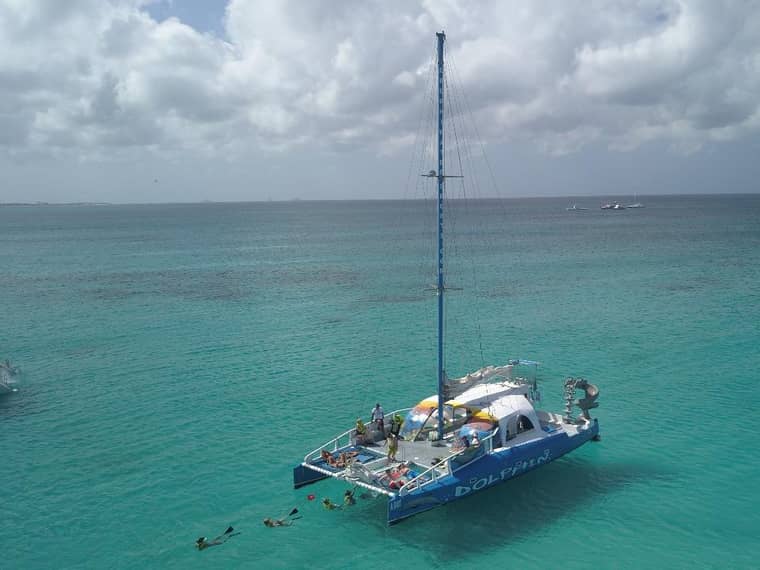
Aruba was Dutch territory and the Netherlands had fallen. When the authorities moved to seize the ship in May 1940, her own crew opened the seacocks and set her alight rather than hand her over.
No torpedo, no battle. That is why she sits upright-ish on a sandy bottom instead of being blown apart — and why so much of the structure is still readable from above.
Around 60 ft of water, with the mast tips reaching to within roughly five feet of the surface. A wreck of this size at this depth is genuinely rare.
Anywhere else in the Caribbean, a 400-foot ship means a certification card and a tank. Here it means a mask.
The site sits off the north-west corner in open water. Chop, wind and a light current are normal, and boats anchor near the wreck rather than over it, so there is a short swim across.
Morning runs, roughly 8–11 a.m., are the calmest water and the best visibility of the day.
Say it plainly, because the photographs do not: snorkellers look down on the upper structure from a few kicks away. Going inside the ship is diving — a different booking with different requirements. The water over it is about 60 ft deep, and it is open sea — expect some chop and a light current, not a pool.
Within roughly five feet of the surface. This is what you look down on from the boat, and it is the whole of what a snorkel ticket buys — a ship, whole and recognisable, a few kicks below you.
The hull, the holds and the corridors you have seen in videos. Tanks, certification and a different operator — not a catamaran ticket. Nobody on any boat on this page goes inside the ship.
She lies on her side on a sandy bottom, in open sea rather than a sheltered bay.
Part of the wreck breaks the water and snorkellers look down on the upper structure — a ship, whole and recognisable, from a few kicks away. It is still a genuinely strange thing to float over. Nobody on a catamaran ticket enters the ship.
If you pictured corridors of steel, you pictured a dive video.
Below the part you can see from the surface, the Antilla is a shallow dive site, and divers go inside the hull where snorkellers only look down. That is a different booking with a different operator and different requirements — start from the snorkelling page.
The boats compared below are snorkel trips, not dives.
Boats anchor nearby rather than directly over the wreck, so there is a swim — a short one. Crews carry flotation vests and noodles and hand them out without ceremony. You need to be comfortable in open water, not fit.
Tell the crew at boarding, not once you are in the water.
Nearly every boat on this page sails the same short north-west route — the differences are the bar, the food and the hours, not the water.
Every boat on this page ends up over the same steel, so the choice is about the day around it, not the wreck. These are the three worth starting from. All seven are compared in the table below.
Antilla first, then Boca Catalina, with appetizers between them. Highest score of the seven. Catch: you board from the beach by shuttle.
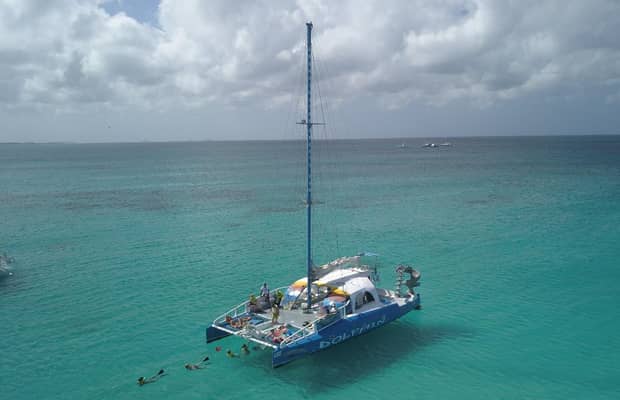
The cheapest wreck ticket on the island and the deepest review record on this page. A tenth of a star lower, and a busier deck.

The longest day here with food off a grill. The extra $50 buys ninety minutes and lunch — not a better view of the wreck.
What separates them is the length of the day, the food and the drink — not the wreck, which is the same steel for all of them. Read the rating column with its review count attached. Live USD prices from GetYourGuide, sampled 21 September 2026. Click any column header to sort.
| Boat | Time | Price | Priced as | Rating | The honest line | Book |
|---|---|---|---|---|---|---|
| Afternoon Sailing Trip with Snorkeling & Open Bar↗ | 3 h | from $74.99 | per person | ★ 4.8388 reviews | Best-rated of the seven — but afternoon, so warmer light, less clarity | Book |
| Snorkel Cruise with Open Bar & Light Lunch↗ | 3 h | from $69 | per person | ★ 4.7437 reviews | Cheapest wreck ticket here and the deepest review record on the page | Book |
| Sailing & Snorkeling Tour with Drinks↗ | 2.5 h | from $70 | per person | ★ 4.7102 reviews | Shortest trip here — the wreck without the rest of the afternoon | Book |
| Boat Trip with Snorkeling & Open Bar↗ | 3 h | from $90 | per person | ★ 4.7148 reviews | $21 over the $69 boat for the same three hours — leaves Oranjestad | Book |
| Champagne Brunch & Aqua Safari↗ | 4 h | from $95 | per person | ★ 4.689 reviews | Four hours and a brunch — you are paying for the table, not the wreck | Book |
| Snorkel with Turtles at WW2 Shipwreck & Sunset BBQ↗ | 4.5 h | from $119 | per person | ★ 4.5168 reviews | Longest day here with a meal — solid record, lowest rating band | Book |
| Sail & Snorkel: Turtles, WW2 Shipwreck & BBQ↗ | 4.5 h | from $119 | per person | ★ 4.770 reviews | Names the wreck in the title; same $119 as the BBQ sail on 70 reviews | Book |
Last updated 21 September 2026. Prices sampled 21 September 2026 — always check the live figure before you book.
This is the question that brings most people to this page, and the answer is short. The Antilla sits off Malmok, in open water beyond safe shore-swimming distance. Every practical route to it is by boat. Do not stand on the rocks at Malmok working out whether you could make it — people talk themselves into that swim, and there is boat traffic out there.
What you can do from a beach on Aruba is snorkel, just not here. The shore entries that work, all reachable on foot from a car park and none of them a wreck:
So the honest framing is this: the Antilla is not a beach you visit, it is a stop you buy. Budget a boat ticket for it and use the shore spots for the mornings in between. Where to base yourself for either is covered on Eagle Beach vs Palm Beach.

Aruba's trade wind is not weather, it is the default condition, and it builds through the day. Flat water before noon, chop after it.
Afternoon boats trade some visibility for things worth having — and the top-rated boat on this page (★4.8 on 388 reviews) is an afternoon sail, which should tell you the trade is not a bad one.
The advice that repeats across traveller reviews and snorkel guides, condensed — none of it is exotic, all of it gets ignored:
The trade wind builds from late morning and the chop builds with it. Roughly 8–11 is the calmest, clearest window at the wreck; afternoons trade visibility for warmer light.
Take the tablet about an hour before boarding — on the pier is too late — and sit near the centre of the catamaran, where the roll is smallest. Cats roll far less than monohulls to begin with.
Aruba restricts oxybenzone sunscreens. Put it on before the marina, top up after each swim — and a rash guard beats reapplying anything out on open water.
Deck spray is constant on the sail home and the three-hour boats rarely hand out towels. A waterproof phone pouch earns its money at the wreck stop.
It is open water over a sandbank, not a lagoon: a light current and surface chop are normal, and crews stay in the water with the group at every stop.
Easy-off footwear, no jewellery, cash for crew tips — tipping is customary on Aruban boats and rarely payable through the booking page.
Seven boats reach the Antilla and the itinerary barely changes between them, so the real choice is deck size and time of day. These are the two we would pay for. Dates and prices are live from GetYourGuide; a date that is not here is sold out.
The cheapest way onto the wreck: $69, ★4.7 from 437 reviews. Two reef stops plus the Antilla, gear included, lunch aboard. Honest catch: it is the busiest deck of the seven.
$74.99, ★4.8 from 388 reviews. Same wreck, roughly half the deck traffic. Honest catch: the wind has been building all day, so the water over the hull reads clearer in the morning.
Live availability and prices via GetYourGuide — free cancellation on most tours up to 24 h before. Our pick is the $74.99 afternoon sail (★4.8, 388 reviews); the cheapest wreck ticket is $69. Everything that floats is on the catamaran & boat cruises page.