Skip to content
12 months compared 18–20 in of rain a year 85–91°F · 29–33°C

There is no bad month in Aruba —
only trade-offs nobody prints.

Aruba holds 85–91°F (29–33°C) all year, takes 18–20 inches of rain across twelve months, and sits at about 12° north on the far southern edge of the hurricane belt. So «when should I go» is not a weather question. It is a question about what you are willing to trade — and the trade is sharper than the brochures admit: the driest, brightest months are also the windiest, busiest and most expensive, while the calmest sea and the cheapest beds arrive with the rain.

The short answer· 01
In one paragraph

There is no bad month in Aruba, and that is the actual answer. The island sits outside the tropics' worst habits: it holds 85–91°F (29–33°C) all year, takes only 18–20 inches of rain annually, and sits at about 12° north — the far southern edge of the hurricane belt. So the question is not «when is the weather good», it is what you are willing to trade. And the trade is sharper than most guides admit: the driest, sunniest months are also the windiest, busiest and most expensive; the calmest water and cheapest beds come in the months that see the most rain.

Month by month· 02

Twelve months, and what each one actually costs you

Temperatures are averages, shown in °F with °C beneath. «Prices» is hotel pricing relative to peak, not tour pricing — tour prices barely move with season. Click any column header to sort.

Aruba month by month: average high and low temperature, tourism season, crowd levels and hotel pricing
MonthAvg highAvg lowSeasonCrowdsHotelsWhat it means
January85°F29°C76°F24°CPeakBusyPeakDry and windy. The island is full and prices are at their highest.
February85°F29°C76°F24°CPeakBusyPeakSame as January, with the trade wind building.
March86°F30°C76°F24°CPeakBusyPeakDriest month of the year — about 0.4 in across roughly 2 days.
April88°F31°C77°F25°CPeakBusyPeakJoint-driest, and the last of the high season. Prices ease at the end.
May89°F32°C78°F26°CShoulderEasier−20–30%Hotels drop 20–30% below peak. Still dry, still windy, far less crowded.
June90°F32°C79°F26°CShoulderEasier−20–30%Hurricane season opens on the 1st, but risk here is minimal this early.
July90°F32°C79°F26°CShoulderMixedMidThe windiest stretch of the year, and choppy water with it.
August91°F33°C79°F26°CShoulderMixedMidHottest month at 91°F / 33°C, and the start of the Atlantic peak.
September90°F32°C79°F26°CLowQuietestLowestWind drops. Calmest water of the year, and the cheapest hotels.
October89°F32°C78°F26°CLowQuietestLowestCalm water, but ~3.0 in of rain across 7–8 days.
November87°F31°C78°F26°CLowFillingRisingWettest month — about 3.3 in over 10 days. Still calm at sea.
December86°F30°C77°F25°CPeakVery busyHighestAbout 3.1 in over 11 days, and the priciest fortnight of the year from mid-month.
Sort by month or temperature — click a header.
Season Peak — busiest and priciest Shoulder — quieter, hotels down 20–30% Low — cheapest, calmest sea, most rain Highlighted rows are the two windows worth planning around

On the figures Temperatures, rainfall and wind are published climate averages, cross-checked against a second set before publication and re-checked each release. Where two sets disagreed we print both rather than pick the friendlier number — you will see that in the wind section below. Averages describe a typical year, not your week.

Rain, in proportion· 03

A whole year of rain is less than one wet British month

Aruba takes roughly 18–20 inches — about 450 mm — across the entire year. For comparison, that is less than London gets, on an island where it falls in short bursts rather than settling in for the day. Here is how it distributes.

Driest

March and April

About 0.4 inches across roughly two days in each month. This is as close to guaranteed sunshine as a Caribbean island gets.

January and February are barely behind, at about two rain days each.

Middling

May to September

Rain picks up gradually through the summer without ever becoming the point of the day. September is the hinge month: the rain starts arriving just as the wind drops away.

Wettest

October to December

November is the wettest month at about 3.3 inches over 10 days; December about 3.1 inches over 11 days; October about 3.0 inches over 7–8 days.

Ten wet days out of thirty still means twenty dry ones — and the sea is at its calmest.

The wind nobody mentions· 04

The trade wind is the real seasonal variable, not the rain

Aruba's constant trade wind is why the heat never feels like 91°F (33°C), why the divi-divi trees all lean the same way — and why the month you pick changes what a boat day is actually like.

What the wind does to your day

It averages around 15–20 mph year-round, and it is the single thing that most changes a snorkel trip, a sunset sail and a beach afternoon.

StrongestRoughly Feb–AugOne source puts the July–August peak at 20–28 knots. Choppier water, less underwater visibility, and a very pleasant beach.
LightestSep–NovThe wind drops away. This is the calmest, clearest water of the year — and the hottest-feeling, because nothing is cooling you.
Every dayMorning vs afternoonWhatever the month, the wind builds through the day. Morning water is calmer than afternoon water, every time.

Published figures disagree on exactly when the wind peaks — some put the strong stretch across February to August, others name July and August specifically. They agree on the part that decides your booking: the wind is strong for most of the year and lightest from September to November. We print the disagreement rather than averaging it into a number nobody measured.

What this means for booking If seeing the Antilla wreck clearly is the point of your trip, September and October give you the calmest, clearest water of the year — in the two months with the cheapest hotels and the most rain. If you want a dry, bright beach holiday, take March or April and accept chop, crowds and peak prices. Both are correct answers to different questions.
The hurricane question· 05

Rare and historically mild — but «zero risk» is marketing

This is the question that decides whether people book Aruba in September at all, so it deserves a straight answer rather than a reassuring one.

The geography

About 12° north

Aruba sits on the far southern edge of the hurricane belt, well below the corridor most Atlantic systems travel. That is why direct strikes are genuinely rare rather than merely lucky.

The Atlantic season runs 1 June to 30 November, with peak activity from August into October.

The one example

Felix, September 2007

Felix passed the ABC islands on 1–2 September 2007 as it strengthened into a hurricane. On Aruba it damaged one house and briefly cut power to a northern town.

That is the concrete example we can point to — and it tells you the honest scale of the thing.

The honest line

Rare, not impossible

You will read «Aruba is outside the hurricane belt, zero risk». Some published guides say exactly that. Others place the island on the belt's southern edge and calls a direct hit rare.

We take the second. Rare is a very good bet; zero is not a number anyone can promise.

What to book, and when· 06

Three trips, and the month that suits each

Tour prices on Aruba barely move with the season — unlike hotels. So the month changes the conditions you get for the same money, which is worth planning around.

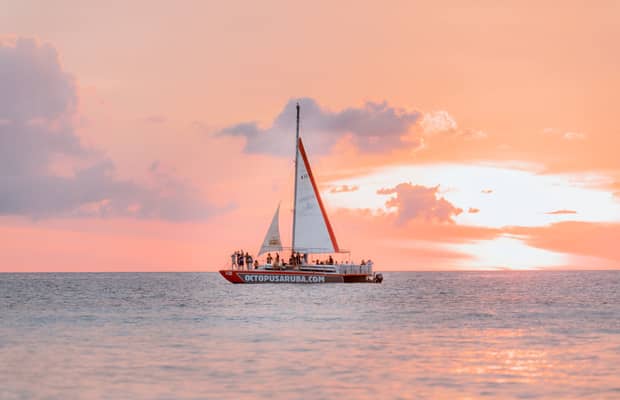
Sunset catamaran cruise off Palm Beach, Aruba

Happy Hour Sunset Cruise

2 hPalm BeachOpen bar

Sunset moves through the year, so check the departure time for your date rather than assuming. Nothing else about this one changes with the season.

from$90
4.8 · 274 reviews
Questions people actually ask· 07

Aruba's calendar, answered straight

What is the actual best month to visit Aruba?
It depends on one choice. March and April are the driest — about 0.4 inches of rain across two days — but they are peak season: busiest, priciest and windiest. September and October give you the calmest sea, the clearest snorkelling and the cheapest hotels of the year, at the cost of the most rain. May and June are the honest compromise: still dry, hotels 20–30% below peak, and the crowds thinned out.
Does Aruba get hurricanes?
Rarely, and history says mildly — but «zero risk» overstates it. Aruba sits at about 12° north, on the far southern edge of the hurricane belt, below the corridor most Atlantic systems follow. The season runs 1 June to 30 November. The concrete example we can point to is Felix in September 2007, which passed the ABC islands and on Aruba damaged one house and briefly cut power to a northern town. That is the honest scale: a real event, a very small one.
Is the rainy season worth avoiding?
Not on these numbers. Aruba takes 18–20 inches — around 450 mm — in a whole year, and even November, the wettest month, means about 10 wet days out of 30 with rain that arrives in bursts rather than settling in. You are trading occasional showers for the calmest water and the lowest hotel prices of the year.
When is the water calmest for snorkelling?
September through November, when the trade wind drops away. That is the clearest underwater visibility Aruba offers, which matters more than anything else if the Antilla wreck is why you came. Whatever month you pick, take the morning departure — the wind builds through the day, every day of the year.
How windy is Aruba really?
Constantly. The trade wind averages around 15–20 mph year-round, and in July and August it commonly runs past 20 knots. It is the reason 91°F, about 33°C, never feels that hot, and the reason every divi-divi tree on the island leans southwest. It is also why an afternoon snorkel is choppier than a morning one.
Are tours cheaper in low season?
Hardly at all — this is the difference people get wrong. Hotels move 20–30% between peak and low season; tour prices barely move. What changes with the month is the conditions you get for the same ticket. See what Aruba tours actually cost for the full picture across 60 tours.
When is Aruba most expensive?
From mid-December through New Year, which is the peak fortnight of the year, followed by January to April. The cheapest beds are in September and October, with May and June sitting 20–30% below peak.
How warm is the sea?
Between about 79°F and 84°F — 26°C to 29°C depending on the month — warm enough that nobody on any boat on this site wears a wetsuit. The air holds 85–91°F — 29–33°C — all year, so there is no month where the water feels cold on entry.

Any month works. The month you pick just changes what you get for the same ticket.

Tour prices barely move with the season — so pick your month for the conditions, then book the tour that suits them. Everything on the island is compared across our eight category pages.

Browse the tours →